
Being able to find information does not, by itself, show how well a person is prepared to deal with complex tasks in life. We also need to understand how they define a goal, check what they find, connect it with their experience, account for constraints and turn conclusions into action. This sequence forms the basis of the proposed approach to information and analytical diagnostics, or IAD.
In this article, IAD means a comprehensive examination of how a person obtains, interprets and uses information to manage their own life and interact with the external environment. The proposed approach draws on Evgen Shvets and Phan Duc Thinh’s book Decision-Making Process Research: its systems view of the human being, its information and cybernetic approaches, the Information Human model and its treatment of the brain as a control system [1].
The purpose of this assessment is to identify strengths and difficulties that emerge when a person works on specific tasks. Its outcome should be an understandable skills profile: what they can already do independently, where they need help and which ways of working they would benefit from learning. Here, “diagnostics” has an analytical and educational meaning. It concerns how a person approaches an activity; it does not establish a medical diagnosis.
The human being and the noosphere as the context for assessment
Human Being. “As an object of study, the human being is regarded as a system possessing consciousness and intelligence and processing information in order to regulate its own life and activity.” [1, glossary, G1, p. 200].
This definition establishes the subject of inquiry. A person belongs to a network of relationships, continually receives influences from outside and changes the conditions around them. Their decisions affect personal life, professional activity, relationships with other people and the use of shared resources. An isolated skill therefore needs to be considered in the situation where it is used. What task does it help accomplish, and what consequences does its use produce?
Noosphere. “The highest stage in the evolution of the biosphere, at which intelligent human activity becomes the determining factor in development. It is the transition from spontaneous development to the coevolution of nature and society.” [1, glossary, G68, p. 211].
Within the book’s framework, the noosphere connects an individual’s development with that of society and the natural environment. For IAD, this raises a question about awareness of consequences: does a person understand that their actions have effects beyond immediate personal benefit? When choosing a technology, for example, its convenience needs to be considered alongside its impact on other participants, the resources available and the long-term conditions in which it will be used.
Knowing the definition of the noosphere is not a measure of readiness for contemporary life. What matters in practice is the ability to recognise connections and relate an immediate goal to wider consequences. In this sense, the noosphere provides a philosophical context for the proposed approach, rather than a separate scale for ranking people.
The Information Human and the extension of human capabilities
Information Human. “The fifth generation of human beings, whose emergence was brought about by the birth of the digital world. That world places specific demands on human life and activity, connected with rapid advances in digital technologies for processing, transmitting, and storing information and with interaction with artificial intelligence.” [1, glossary, G30, p. 206]. Excerpt from the definition.
The term “fifth generation” belongs to the authors’ account of historical development. The idea relevant to this article is that changes in how information is handled require people themselves to develop. In the authors’ model, a personal computer and a smartphone are added to the three components “Body & Mind & Soul/Psyche”. Together they form a five-component representation of the Information Human [1, pp. 33-36].
In this model, Body refers to the physical component and the support of life and activity. Mind is associated with interpreting information and solving problems. Soul/Psyche encompasses the inner world, emotional processes, values and expressions of will. The computer and smartphone are external tools that extend access to data and the capacity to process, store and transmit it. This is the authors’ functional model for examining relationships among different aspects of human activity.
For the purposes of IAD, owning a device needs to be distinguished from being able to accomplish a task with it. Someone may use a smartphone every day yet struggle to verify a source, organise files or compare possible decisions. Conversely, proficiency in a particular application does not establish an ability to formulate a meaningful goal. Assessment therefore needs to connect a digital skill with the result of its use.
The same reasoning applies to interaction with artificial intelligence. The proposed assessment can examine whether a person can formulate a request, supply context, check the grounds for an answer and explain why they accept or reject a suggestion. Independence is expressed through continued, deliberate control over the decision. A digital assistant’s output becomes material for analysis, while the person remains responsible for its use.
Three approaches to studying human activity
The book presents the systems, information and cybernetic approaches as interconnected foundations for analysing complex objects [1, pp. 51-52]. Within IAD, each supports a different set of questions and reveals a particular aspect of the same activity.
Systems approach. “A method of representing any object as a set of interrelated elements organised hierarchically at different levels.” [1, glossary, G19, p. 204].
A systems examination begins with the whole: what personal or professional task is the person trying to accomplish? Relevant elements, constraints and relationships are then identified. A difficulty with learning, for example, may relate to existing knowledge, time management, access to materials or an unclear goal. Understanding these connections helps determine what deserves closer examination. The depth of analysis follows the purpose of the assessment; every aspect of someone’s life does not need to be described in equal detail.
Information approach. “Treating an object as a system for processing and storing data, with an input - the receipt of information - and an output - the result of processing it.” [1, glossary, G41, p. 208].
Here, attention follows the path of information. What does the person receive? How do they choose sources, retain what matters, distinguish observation from assumption and connect new data with existing knowledge? The output may be an understanding, a possible decision or a plan of action. This perspective helps locate difficulties in searching, selecting, interpreting, comparing or using information.
Cybernetic approach. “Representing an object as a feedback control system. The system analyses information at the output and, where necessary, applies a corrective influence to the control program in order to achieve the required result.” [1, glossary, G42, p. 208].
For IAD, this means extending the examination of reasoning to actions and their consequences. A person specifies the expected result, chooses a course of action, observes what happens and adjusts the plan if necessary. A significant feature is the willingness to revise an initial conclusion when experience contradicts it. Without feedback, even a clearly expressed intention remains untested.
Used together, the three approaches trace an entire sequence: the structure of a situation, the acquisition and processing of information, the choice of an action, its outcome and subsequent adjustment. Examining an individual error becomes more informative when we know what data was available, how the person understood it and what changed after new information arrived.
The brain as a control system for human activity
The brain’s directing role is central to this approach. The book develops this idea through a structural and functional model that includes information input and output, memory, information exchange and different levels of processing. Figure 2.2 brings these elements together in a model of the control of human activity [1, pp. 57-58].
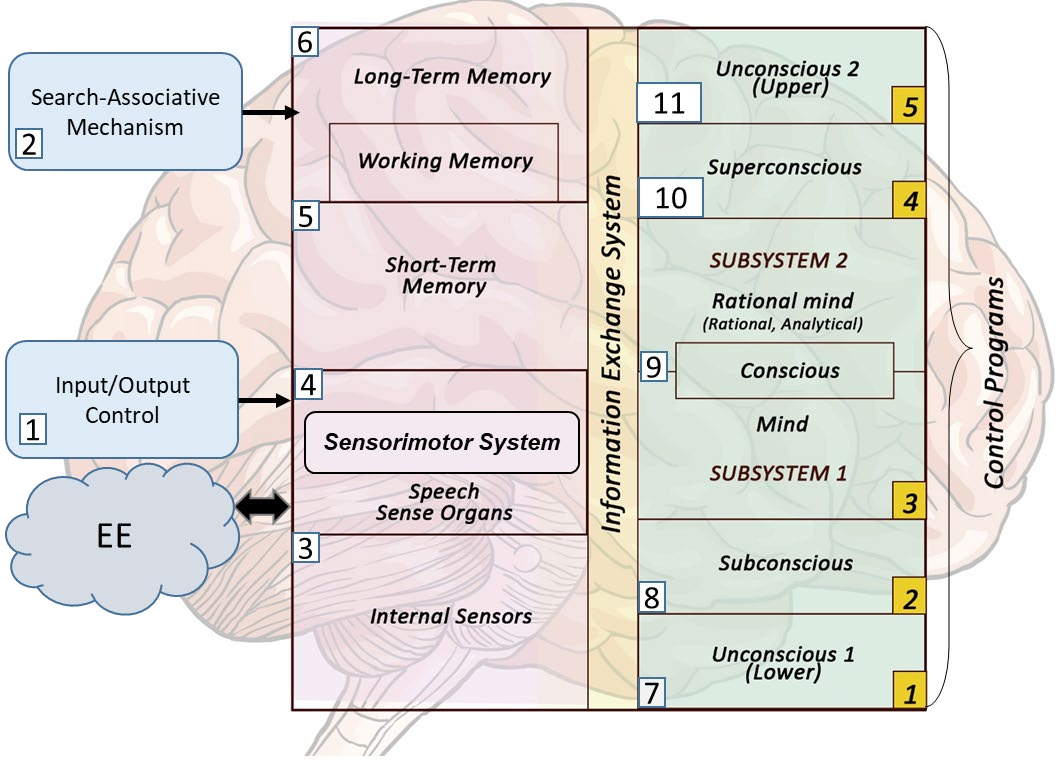
For the proposed assessment, the diagram suggests a sequence of inquiry. First, what did the person notice? Next, what did they retain and compare it with? Then, how did they interpret it, what decision did they form and how did they act on it? An incomplete answer to a task may arise from an overlooked condition, missing knowledge or an ineffective line of reasoning. These causes call for different responses even when the outward result looks the same.
This model is useful when discussed through observable actions and the person’s own explanations. One unsuccessful decision does not establish that a particular brain subsystem is “not working”. The conscious, subconscious and unconscious processes labelled in the figure belong to the book’s model. Within IAD, they help organise questions about activity but do not themselves constitute a means of measuring the brain’s condition.
Model-based thinking. “The ability to forecast, or anticipate, future states of an object or system on the basis of different combinations of the possible states of its elements.” [1, glossary, G66, p. 211].
In a practical discussion, this definition can be explored through questions about possible changes. What would happen if less time were available, the initial conditions changed or the chosen method failed to produce the expected result? Considering several scenarios helps assess both the person’s knowledge of the present situation and their understanding of the relationships that shape subsequent action.
Interaction with the external environment
External environment. “The totality of living and non-living natural objects, together with the phenomena and processes with which a person interacts in the course of life and activity.” [1, glossary, G2, p. 200].
The book’s basic diagram shows mutual influences between a person and the external environment. External signals arrive through the senses, enter internal processes and contribute to a response. The person then acts on the environment and receives new information about the consequences of their actions [1, pp. 102-103].
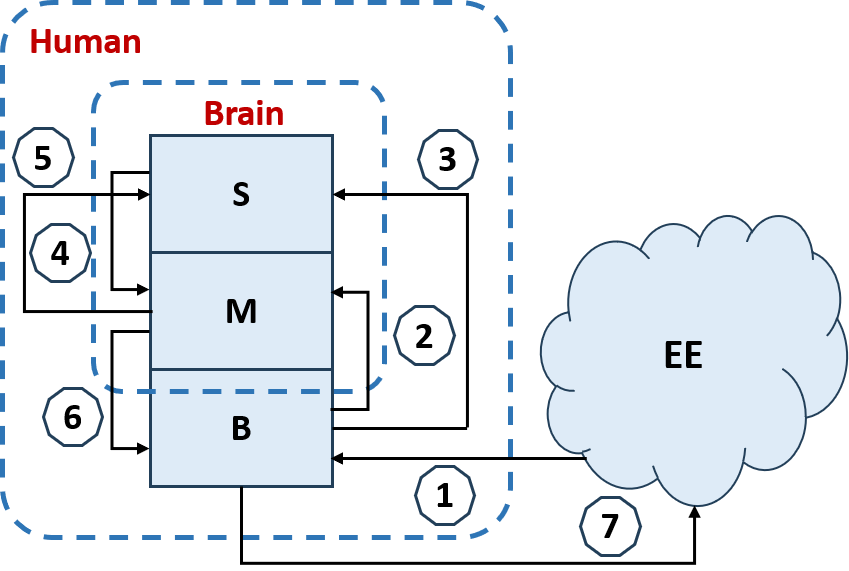
In the diagram, EE means external environment, B means Body, M means Mind and S means Soul/Psyche. For assessment, the essential point is that an action takes place under particular conditions. If a task remains unresolved, we need to establish whether it was understood, what tools were available, which constraints applied and whether the person received information about progress. This helps distinguish difficulties in the way the task was approached from obstacles created by the situation.
The expanded diagram adds a personal computer, smartphone, and material and financial assets. Within the external environment, it identifies society, the Internet, artificial intelligence and big data. This extension connects a person’s internal capabilities with the tools and resources available to them [1, pp. 103-105].
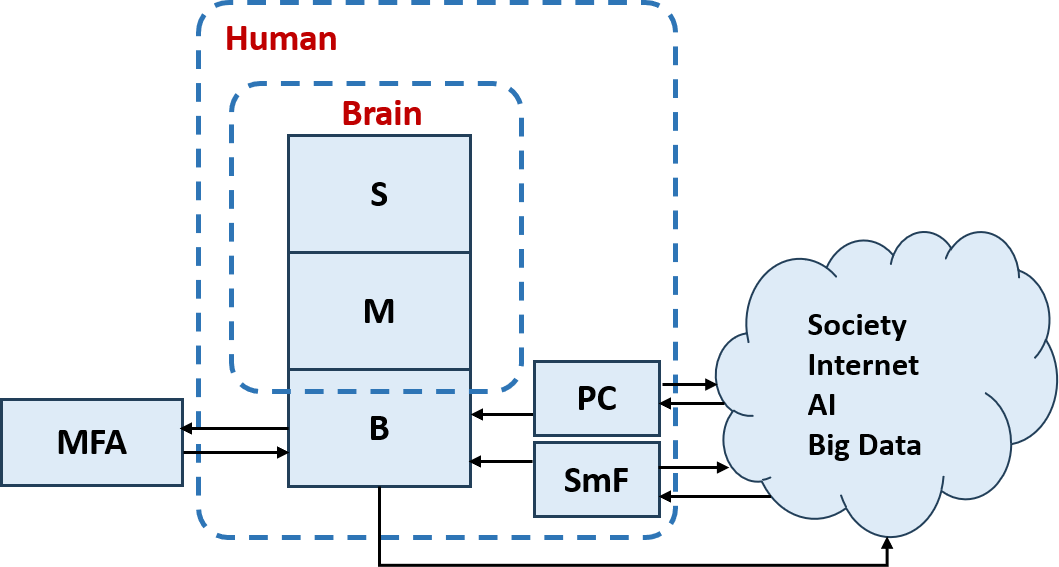
PC denotes a personal computer, SmF a smartphone and MFA material and financial assets. Their inclusion shows that achieving a goal depends on both resources and the way they are used. In the proposed IAD approach, resources should be considered as conditions of activity. Their quantity does not, by itself, determine the quality of a person’s thinking, readiness to learn or worth as an individual.
What information and analytical diagnostics can assess
Several interconnected areas of assessment can be derived from the model. The following is a practical interpretation for IAD. It develops the book’s ideas rather than reproducing an established diagnostic test.
Goal setting. Can the person describe the intended result, explain why it matters and identify constraints? Observable evidence includes the task they formulate, the signs by which they would recognise success and their understanding of which requirements are negotiable and which are essential.
Working with information. Which sources does the person choose, how do they verify information and what do they do when sources disagree? The basis of an answer matters alongside the answer itself. Particular attention should be paid to the ability to acknowledge missing data and identify what is actually needed.
Systems and model-based thinking. Can the person identify the significant elements of a situation, reconstruct their relationships and consider the consequences of change? This can be observed when they compare options, explain a choice and discuss alternative scenarios.
Using digital tools. What can the person do independently: find material, organise its storage, create a table, prepare a document, use communication tools or check an AI response? Assessment should focus on accomplishing a meaningful task and understanding why a particular tool was chosen.
Self-regulation and interaction with others. Does the person notice when haste, irritation, anxiety or a wish for immediate approval has influenced a decision? Can they return to the task’s conditions, clarify what is unclear and discuss a disagreement? Specific episodes and how they were handled provide material for analysis.
Learning through feedback. Does the person compare expectations with actual outcomes, draw useful conclusions from a discrepancy and change what they do next? This reveals whether experience is being translated into an improved way of solving problems.
A profile of this kind must remain tied to context. Confident performance in familiar work does not guarantee the same result in a new field. An assessment is more useful when it states which task the person completed independently and what assistance was required than when it assigns a general label such as “prepared” or “unprepared”.
Organising a practical assessment
Decision-making process. “An information process occurring in the human brain during interaction with the external environment. It is based on a structured method that includes analysing the problem, collecting information, selecting the optimal alternative, and evaluating the results.” [1, glossary, G3, p. 200]. Excerpt from the definition.
This definition supports organising assessment around a complete task. The book’s practical method is structured around the questions “What should be done?”, “When?” and “How?”. For the proposed IAD approach, they can provide a basis for discussion and observation [1, Chapter III]. The sequence below is a possible working format. It would still need separate evaluation in the development of a full assessment method.
1. Define the subject and conditions. Begin with a situation that matters to the person: learning a new way of working, planning a project, choosing a training programme or organising a shared activity. Clarify the goal, timeframe, resources and criteria for the result. This establishes the boundaries of assessment and helps avoid abstract judgements about personality.
2. Identify the initial model of the situation. The person describes the situation, identifies its elements and explains what is known, what is assumed and what needs clarification. This reveals their initial understanding, habitual explanations and points at which confidence is not supported by evidence.
3. Follow the handling of information. Observe the search for information and its comparison: how sources are chosen, findings recorded, contradictions checked and digital tools used. Retain a record of the work, such as notes, links, a comparison table or a short explanation of the search process.
4. Compare options and explain the decision. Consider possible actions. The person explains which options they identified, how they compared them and why they selected one. Discussing a change to at least one significant condition helps reveal how much the choice depends on its assumptions.
5. Obtain feedback. Where the task allows a small, reversible step, test the chosen approach in practice. Compare the expected and actual results and examine the reasons for discrepancies. If action is not yet possible, discuss its consequences as a forecast and retain that distinction in the conclusions.
6. Create a development profile. Record the observed strengths, difficulties, assistance required and one or more skills to work on. If the assessment is repeated, compare the tasks and conditions. Otherwise, it is impossible to tell whether improvement reflects a newly acquired way of working or simply an easier assignment.
At an early stage, descriptive conclusions are appropriate. A numerical scale would require separately justified tasks, scoring rules and evidence supporting the reliability and interpretation of its results. Neither the book’s diagrams nor the proposed sequence establishes those standards on its own. In the format discussed here, the outcome of IAD is therefore a substantive description of activity under specified conditions.
An example involving the choice of training
Consider a hypothetical example illustrating the proposed format. A professional wants to learn an application used to prepare work reports. Initially, they define the task as “finding a good course”. Further discussion establishes the intended result: preparing a particular type of report independently within the working time available. This formulation makes it possible to identify the training topics needed and how the usefulness of the course could be tested.
A systems analysis connects the training with current responsibilities, existing knowledge, available time and the requirements for the result. An information analysis examines how the person compares course programmes. Do they rely only on descriptions and reviews, or do they also investigate practical assignments, software access and opportunities for feedback? Their use of digital tools is evident in how they find materials, retain sources and organise the comparison.
Within a cybernetic approach, they could complete a sample learning exercise and then prepare a small report using familiar material. Comparing the expected and actual outcome helps identify what needs further work. The difficulty might concern the application’s functions, or it might be that the person does not yet know how to structure the report itself. These situations lead to different assessment conclusions and different learning needs.
The example shows how assessment extends beyond asking whether a person knows an application. It covers goal setting, the choice of information, the use of a tool, checking the outcome and changing the plan. The conclusion remains connected to a particular task and does not automatically extend to every aspect of the person’s life.
From assessment to deliberate development
In the proposed interpretation, information and analytical diagnostics connects the study of a person with their actions in real circumstances. The noosphere provides a broad context of responsibility. The Information Human model draws attention to the interaction of internal capabilities and digital tools. The systems, information and cybernetic approaches support a step-by-step examination of the situation, information, decision and result.
The practical value of IAD depends on the specificity of its conclusions. A person should be able to understand which actions help them accomplish a task, where difficulties arise and which observable signs indicate change. Assessment then becomes part of learning and personal development: new ways of working are tested through activity, and the resulting feedback helps refine goals and subsequent actions.
Source of definitions and illustrations
[1] Shvets, E., and Phan Duc Thinh. Decision-Making Process Research. How to Learn to Manage Your Life. How to Become Successful. English version, 2026.
References use the printed page numbers of the English version, which are two lower than the PDF page numbers. Illustrations are reproduced from the original with their labels preserved: Fig. 2.2, p. 58; Fig. 3.1, p. 102; and Fig. 3.2, p. 104. Definitions are quoted from the glossary, with excerpts identified separately. Line breaks and end-of-line word divisions have been removed, and dash typography has been normalised for the website.
Prepared by the editorial team using ideas from the book. The situations are examples created for this journal.