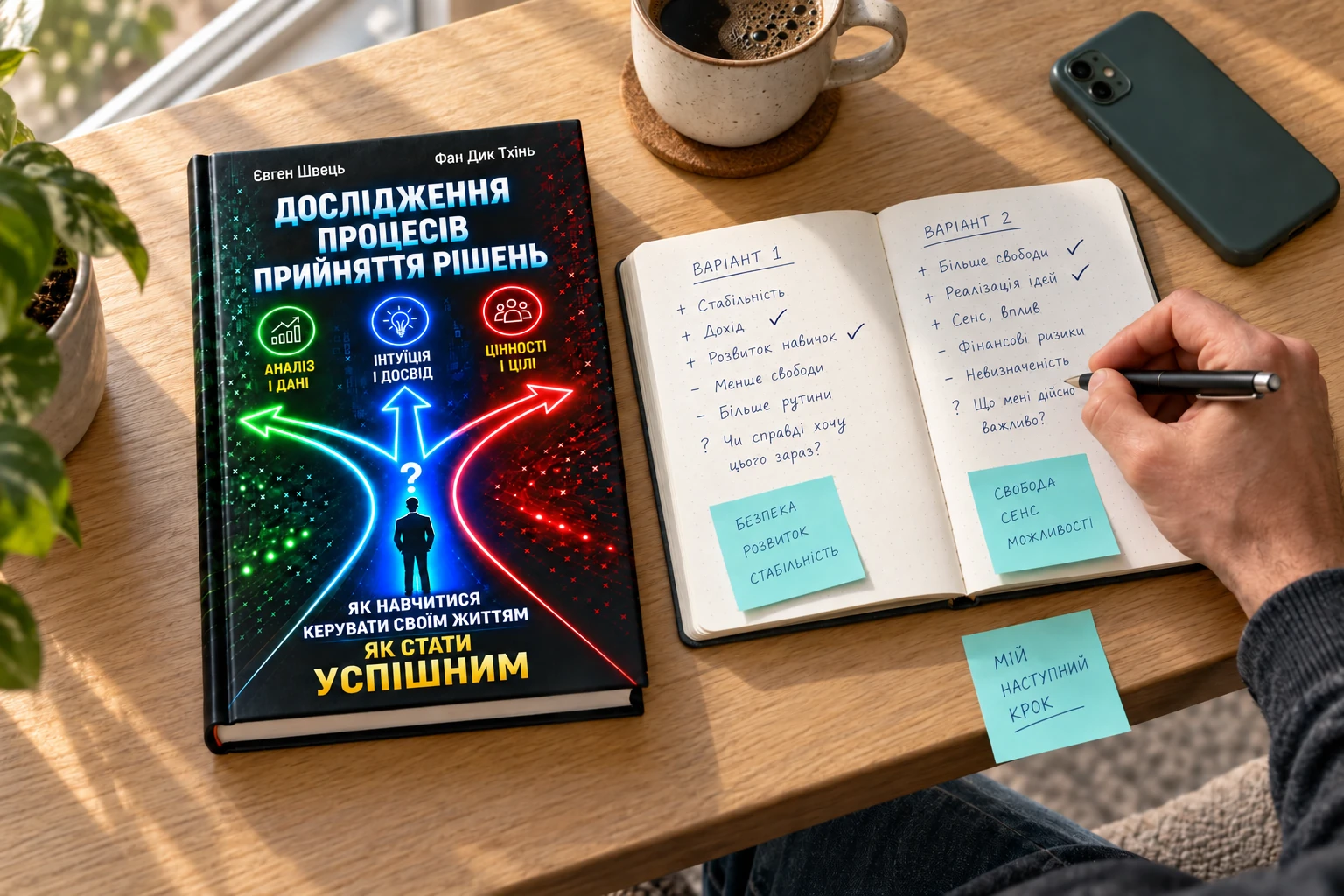
Why does the same amount of information help one person decide while leaving another more confused? How can we see a problem as a whole, identify the relevant data and tell whether an action brings us closer to a goal? These questions run through Decision-Making Process Research, the book by Evgen Shvets and Phan Duc Thinh.
This review uses the supplied 2026 English version of the book. Its diagrams and page references come from that version. Its focus is a person interacting with the environment, processing information and directing their actions. The authors bring together three approaches: systems thinking describes the structure of a situation, the information approach examines data processing, and the cybernetic approach examines control through feedback.
From a model of the human to a specific decision
Four chapters move from a broad conceptual framework towards practice:
- Human development and information processing. The authors propose a hypothesis about generations distinguished by their ways of working with information, introducing the Information Human.
- The brain as a system for managing life. This chapter explores the authors’ functional model of the human, conscious and unconscious processes, and different forms of thinking.
- Exploring the decision-making process. The What, When and How method connects task selection and priorities with modelling and comparing alternatives.
- How to become successful. The discussion turns to developing thinking, communication and the ability to work in a digital environment.
A glossary concludes the main text. It is useful because the authors give some familiar words particular meanings within their framework.
The systems approach: understanding the whole and its connections
On page 51, the authors describe the systems approach in terms of interconnected elements organised into levels. This perspective asks what makes up a situation, how its parts affect one another and which larger system it belongs to.
Pages 93-96 identify three principles. Hierarchy places a system within a higher-order system. Multiple levels allow progressively more detailed descriptions. Multiple stages help examine a process and its cause-and-effect relationships. Analysis separates the whole into parts; synthesis brings them together with their interactions in view.
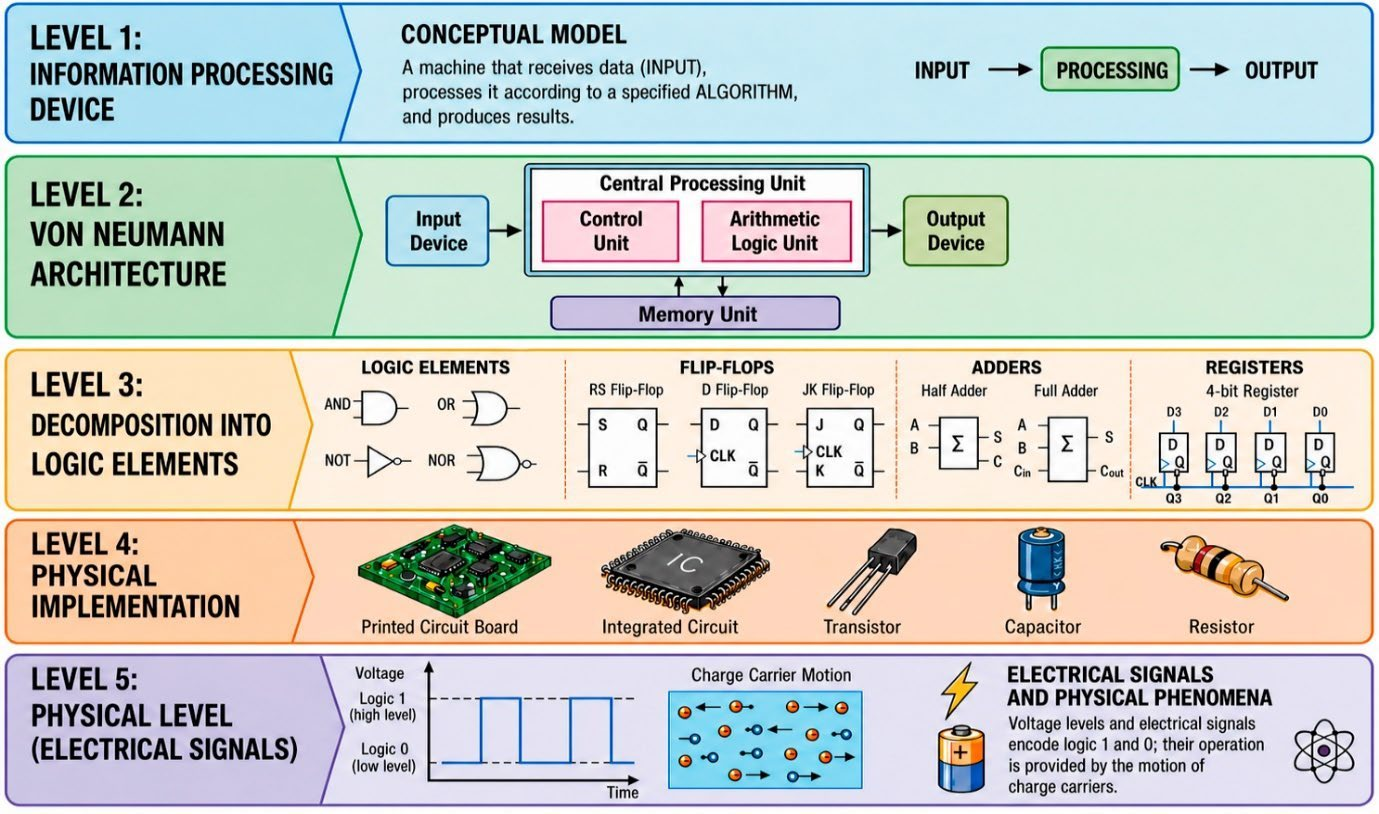
An editorial example: choosing a new job. First, consider work as part of your life: income, time, family and development. Then examine the elements: what makes up the income, how long the commute takes and which skills the role develops. Finally, reconnect them: higher pay might come with less time for learning or rest.
The practical result is a map of the decision showing relevant elements, constraints and the consequences of their interactions. It helps reveal when improving one measure makes the overall situation less desirable.
The cybernetic approach: acting and receiving feedback
In the book’s definition, a control system analyses output information and, when needed, adjusts its programme of action to move towards the required result (pp. 51-52; glossary entry G42). A decision becomes part of a recurring process: action changes the situation, and observing the outcome informs the next action.
Practical application requires a goal, a means of influencing the situation, an observable outcome and an opportunity to adjust. Feedback becomes useful when information about consequences actually changes subsequent behaviour.
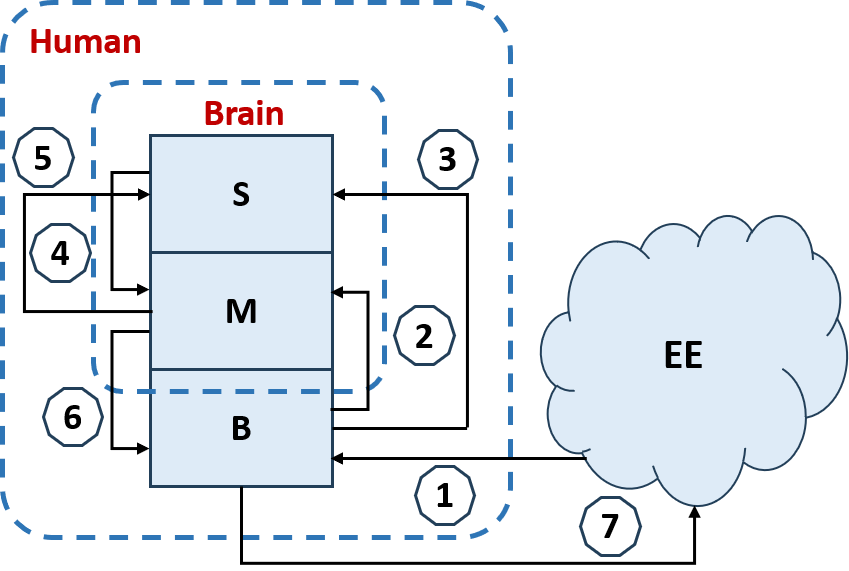
Returning to the job example, suppose the goal is professional development with a manageable workload. Before moving, identify signs of progress: the work itself, time for learning and the length of the working day. After starting, compare expectations with experience. A mismatch can prompt a discussion about responsibilities or a change in how time is organised.
This goes beyond judging whether the move worked: it identifies what needs adjustment. In this editorial interpretation, an error supplies information for control, and checking the outcome becomes part of the decision itself.
The information approach: tracing the path from data to action
The authors consider an object as a system that receives, stores and processes data to produce an output (p. 51; G41). Applied to a person, this separates incoming information, memory and experience, methods of interpretation and the resulting decision.
In the practical method, information gathering follows problem formulation: first define the goal, parameters and criteria, then collect the data needed to address them. The book also considers the time available, the reliability of information and uncertainty (pp. 128-138).
In the job example, a vacancy notice, a conversation with a manager and the terms of an offer are different sources. A promise of “plenty of development” still needs clarification: which tasks, who you can learn from and whether time is set aside for learning. Comparing those answers with your goal turns a set of messages into a basis for choosing.
Computers and smartphones extend storage, processing and communication in the book’s model. Their role depends on how people use them: the questions they ask, the data they check and the conclusions they draw.
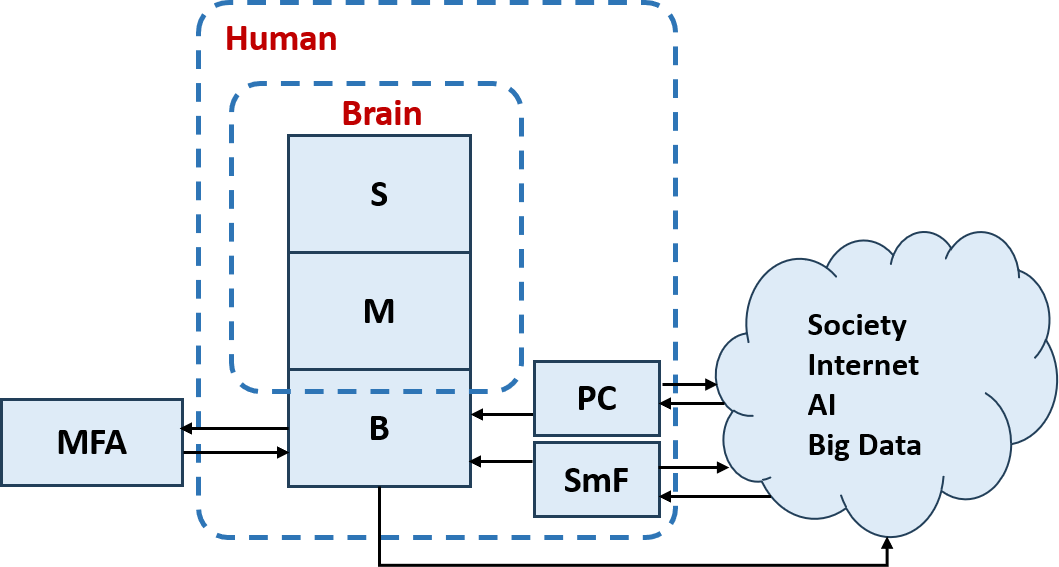
In our example, the three approaches address different questions: what is connected to the job choice; which information is needed for comparison; and how to check consequences and adjust actions. Together, they connect understanding a situation with acting within it.
The What, When and How method
The authors write their method as “(What ∨ When ∨ How) & Do It”, combining what, when and how with taking action. Its three parts address successive tasks.
What should I do? Decide which problems actually need solving in relation to the goal. The authors use a tool they call the Cartesian square, examining the consequences of acting and of not acting.
When should I do it? Arrange selected tasks by importance and urgency using the Eisenhower matrix. This connects intentions with the time available.
How should I do it? Follow five stages: assess the situation and time; formulate the problem; gather relevant information; identify alternatives; evaluate and compare them to select a solution. The diagram also includes risk assessment during the first four stages.
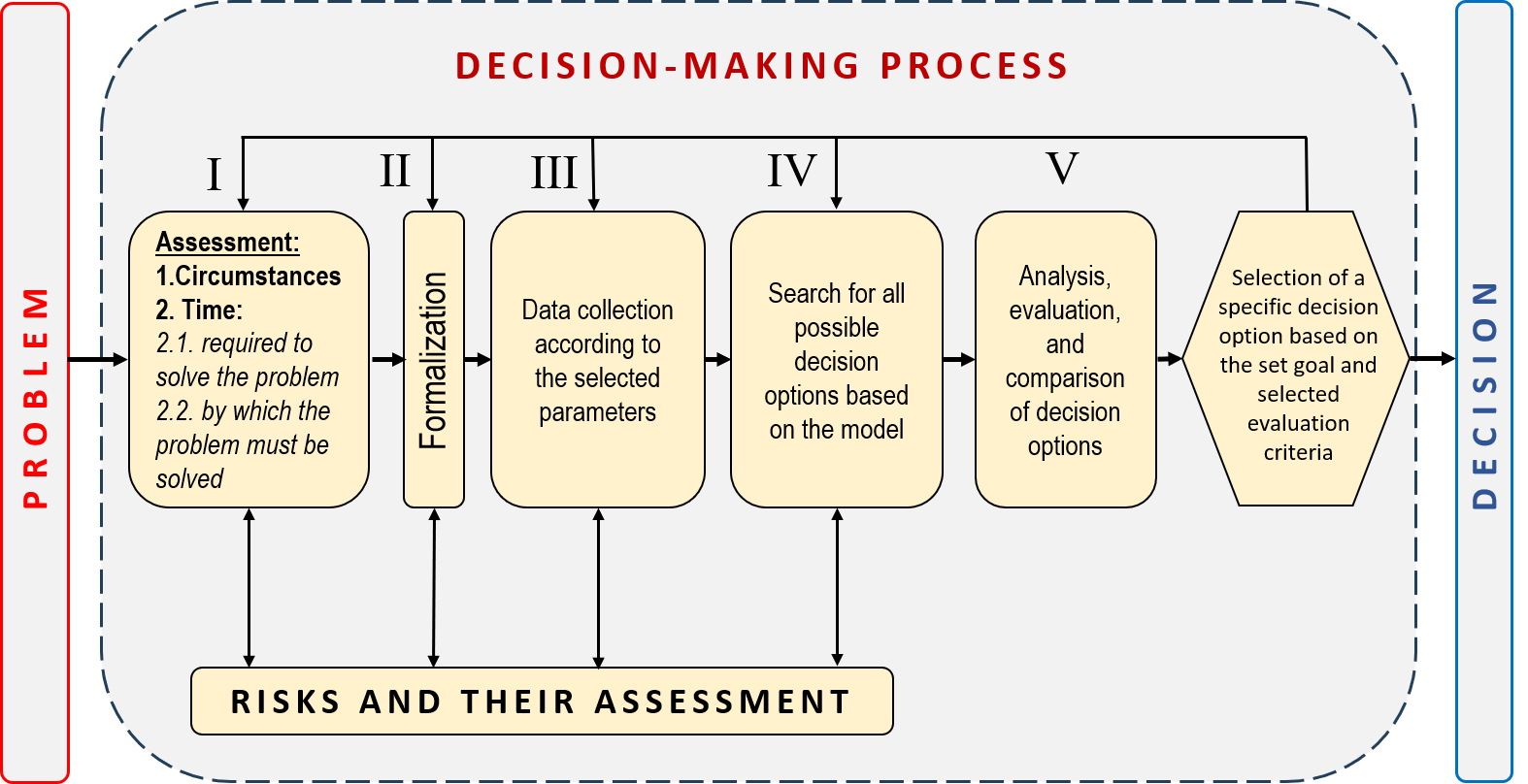
The book places particular emphasis on formulating the problem. A vague wish to change something becomes a task with a goal, parameters, criteria and constraints. The authors propose eight factors: goal, time, parameters, evaluation criteria, a criterion for excluding insignificant factors, the current state of the person and environment, and the problem’s complexity and significance (pp. 128-137).
Six terms that help explain the book
- Decision-making process (DMP). Working with a problem and information to choose an alternative and evaluate results. Glossary entry G3.
- External environment (EE). Natural objects, people, phenomena and processes with which a person interacts. G2.
- Multiple levels. Successive descriptions of a system with increasing detail about its elements. G64.
- Model-based thinking. Considering how a system’s future state may change under different combinations of its elements. G66.
- Materiality threshold. The authors’ filter for leaving out parameters that are insignificant for a particular task. Its threshold depends on the goal and scale of the decision (p. 135).
- Information Human. The authors’ concept of a person whose information capabilities are functionally extended by a computer and smartphone (introduction, pp. 3-4).
These definitions are abbreviated paraphrases for this review. The original wording is in the specified sections of the English text.
What the book offers
The book’s most practical contribution is its progression from a broad problem to comparable alternatives. The three approaches provide a language for that progression: describe relationships, identify needed data, organise action and check its outcome. This makes it useful for readers seeking a more deliberate way to examine personal and working situations.
Readers should distinguish practical tools from the authors’ broader conceptual framework. The five generations of humans, the three-part “Body & Mind & Soul/Psyche” model and its digital extension are presented here as the book’s concepts. A clear illustration does not itself establish the scientific validity of every associated assumption. The method can organise reflection, but it does not guarantee the success of every decision.
Source: Evgen Shvets, Phan Duc Thinh. Decision-Making Process Research, the 2026 English version supplied for this article. References use printed page numbers, which are two lower than the PDF page numbers. Figures 2.9, 3.1, 3.2 and 3.7 come from the book; the job-choice example was created by the editorial team.
Read about the book and available editions, or apply the questions to your own situation in the decision walkthrough.
Prepared by the editorial team using ideas from the book. The situations are examples created for this journal.