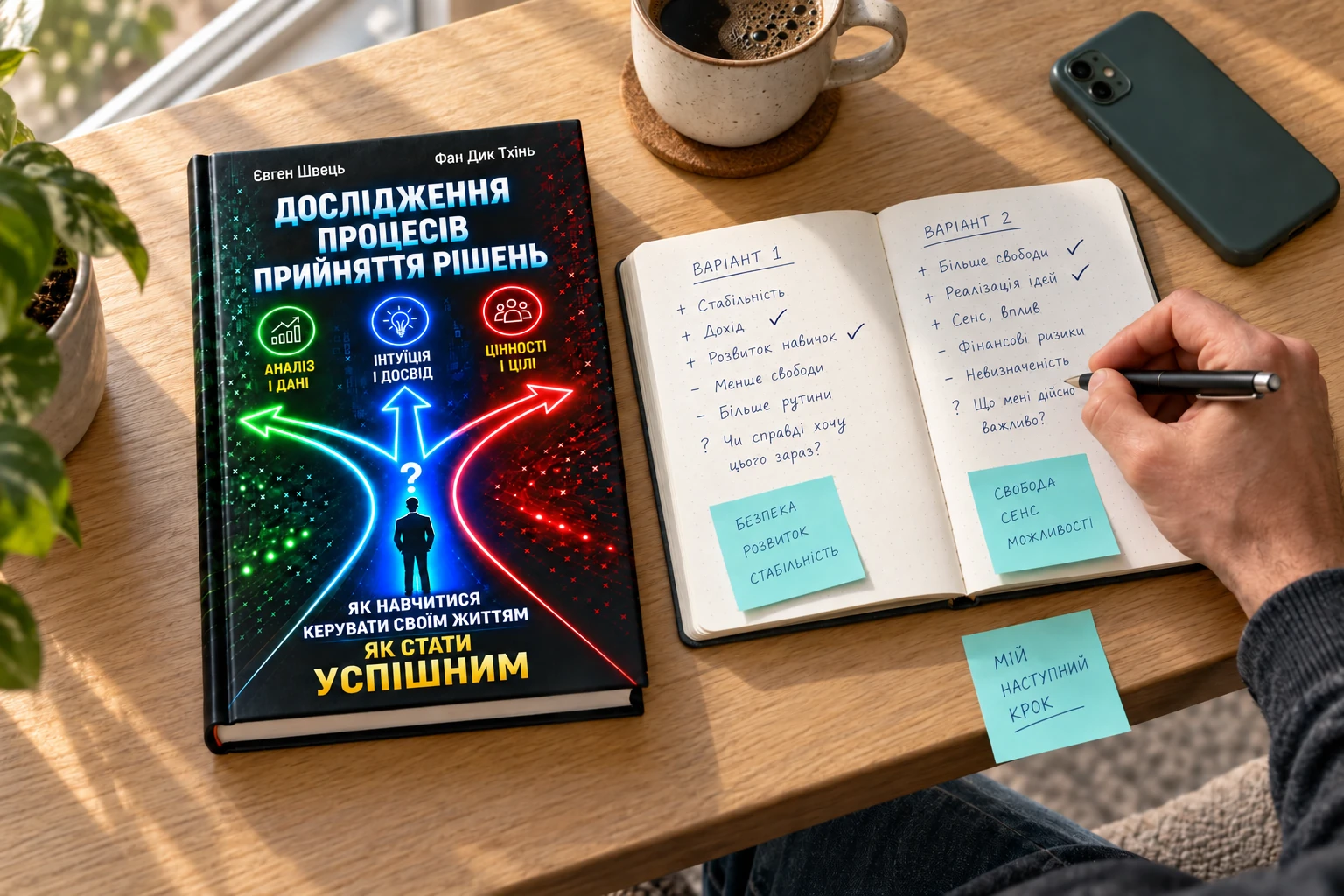
You have almost chosen a course, a phone or a way to solve a problem. All that remains is “a little checking.” Most of the reviews you find are positive. The others seem unconvincing. What exactly are you checking?
When a conclusion feels appealing, it is easy to select information that fits it. Critical thinking, one of the ways of working with information discussed in the book, starts with a willingness to examine your own model.
Separate your conclusion from its basis
“This course suits me” is a conclusion. “The syllabus includes the topic I need” is one reason for it. The conclusion may be correct, but one reason is not enough to assess all the relevant conditions.
Make two short lists: what you know and what you assume. Note the source of each claim. Someone else’s review describes their experience; it does not guarantee the same result for you.
Ask an uncomfortable question
“What information would make me reject this option?” It might be a lack of practical exercises, an unsuitable level or a schedule that conflicts with work.
If the answer is “Nothing,” the checking may have become a formality. Return to your goal: what outcome do you actually want?
Consider a strong alternative argument
Try to state the best reason for choosing another option. Give it the form that a thoughtful person could seriously defend.
Then check the key fact. For a course, ask for a sample exercise or a description of the entry requirements. That action may be more useful than another hour of reading reviews.
“What could change my mind?” turns checking into a specific task.
Record the conditions of your decision
Finish with: “I choose this option because…; I will revisit the choice if…”. You preserve the ability to respond to new information while staying clear about your current decision.
Prepared by the editorial team using ideas from the book. The situations are examples created for this journal.